
There is no better way to get a landscaping or lawn care professional worked up than by insisting that they should go electric. Or if they have gone electric, suggesting to them that they wasted money. And with good reason: With over $10 billion a year spent annually on lawn and garden equipment, there is a lot at stake for landscapers to get right.
Generally speaking, supporters of electric equipment rave about lower maintenance costs, quieter operations and the benefits of less fumes. Gas-powered boosters like the cheaper upfront costs (especially when you account for extra batteries) and believe them to be more reliable and powerful.
An objective calculator
We set out to help resolve this debate by building the industry’s most accurate model to evaluate whether to buy battery or gas-powered equipment. We compared mowers, string trimmers and leaf blowers, and our calculator included:
- Equipment costs
- Historical gas and electricity prices by state
- Battery costs
- Battery capacity or runtime
- Details about the type and scale of business that you run
- And many other variables
In building this calculator, we first calculated the total upfront cost of electric and gas equipment. Total upfront costs include the cost of the equipment itself, and in the case of electric equipment, also include the cost of the additional batteries you would need to make it through a full workday.
Next, we calculated the operating costs. This is where the cost of electricity and gas come into play, as well as the maintenance costs for replacing broken or worn-out parts (gas machines tend to have many more of these than battery-powered ones).
Finally, we predict the change in these prices based on inflation.
The result is a break-even over a three-year period, which seems to be the useful life of most equipment. Break-even is the upfront cost plus annual operating costs. In Fig. 1, you can see an example of the kind of results you would find for our home state of Washington.
Residential results
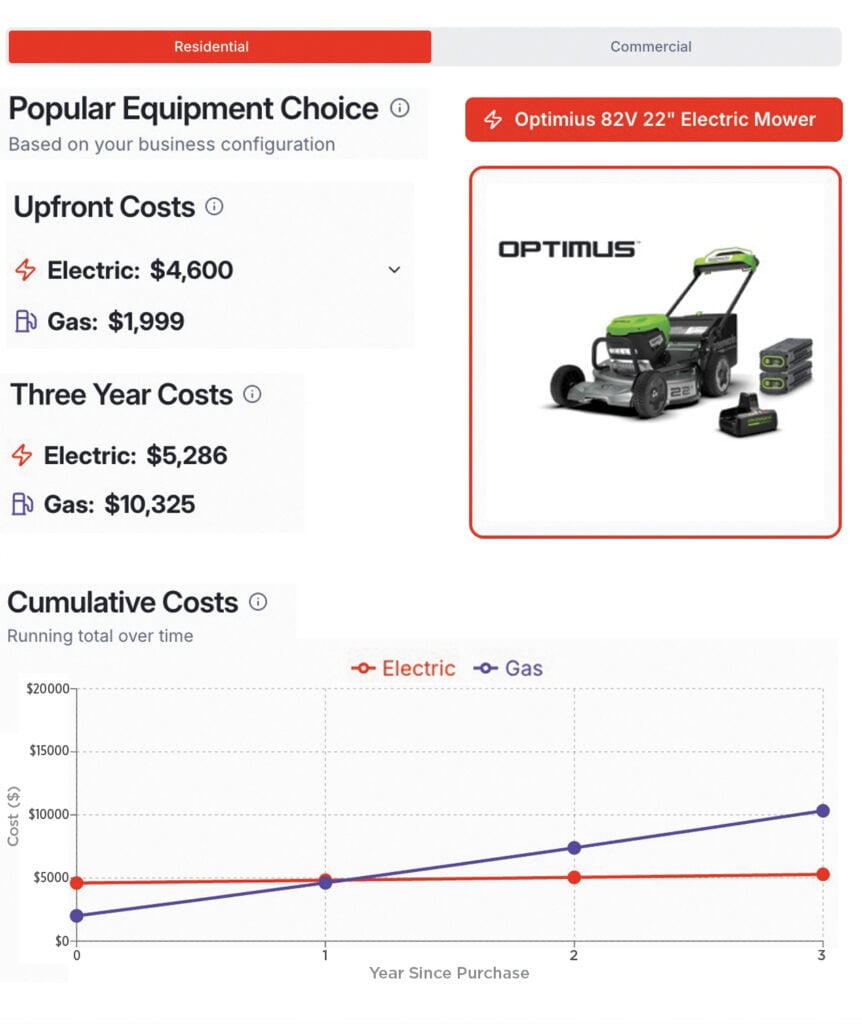
For residential properties (properties with less than an acre of land), we could not find a single state where it made economic sense to choose gas over electric equipment for mowers, trimmers or blowers.
And this was true with walk-behind mowers, as well, because these machines are quite efficient — you don’t need a ton of extra batteries for them, and the savings on electricity pay for themselves in just over a year in most states (Fig. 2). Perhaps this is why I could not find a single gas-powered 21-inch mower at Equip Exposition in Louisville last October.
Commercial results
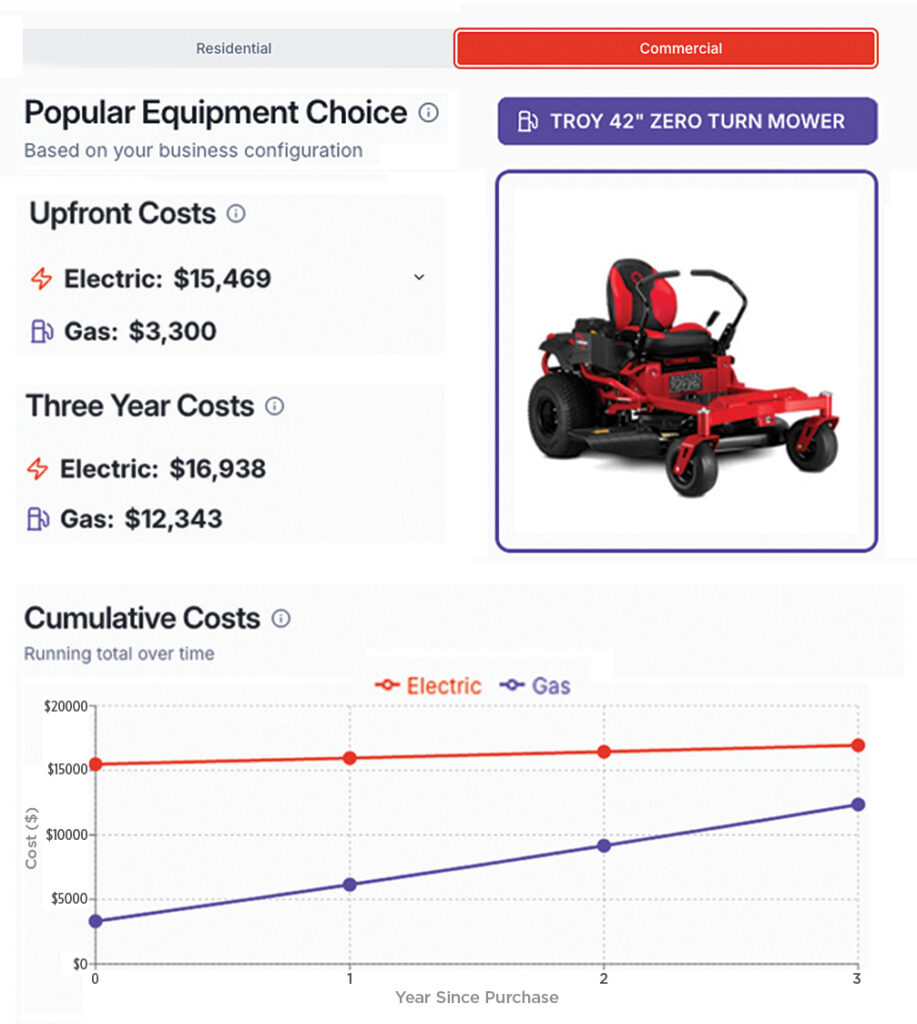
The commercial sector is a little more mixed; for mowers, it almost never makes sense to go electric, for blowers it varies by state and for trimmers, electric wins across the board.
At this point in time, the cost of extra batteries (not to mention the logistics) for zero-turn mowers and similar large equipment outweighs the savings associated with operating them. So gas-powered equipment continues to win in those scenarios.
There is one exception: California. In California, it is always a positive investment to go electric.
You can try out the model and download the results for your state here.